Using music on TikTok is the most important driver for the video-driven social media platform. TikTok and music have actually belonged together since the early days of the platform. Especially nowadays, it has become one of the most important marketing tools for major labels. There is no easier and better way to increase awareness and attention for an artist and a release. It is not without reason that the majors have fixed contracts with influencers to keep pushing their new records
When commercial music is used on TikTok, it is also clearly in the foreground. It is danced to, sung to, made nonsense of or it is clearly pointed out that artist XY has a new release and that it is really cool and the influencer listens to it all the time. With very successful and authentic influencers, the latter is almost a guarantee for a certain amount of (temporary) streaming attention.
Then there is a second case. This is more for the professional content creators
out there. Here the music is used dramaturgically, comparable to normal moving image productions.
What is normal these days? Exactly in comparison to classic TV productions, where the music is supposed to support the dramaturgy, where it is supposed to emotionalize, where it is supposed to ironize, where it is maybe supposed to underline a joke. That's exactly how the music is used in TikTok.
Or no music is used at all. Of course, this may be for the reason that no music is to be used, but just as often it happens that the user is not sure whether he is allowed to use the music.
The dramaturgical use of music can make a huge difference between a video being entertaining or less entertaining and successful or unsuccessful.
Now there is a big question.
Is the use of music on TikTok legal?
To answer the question, I actually have to take a step back, namely to an important point, to the question "Where are music and image actually put together?", i.e. where are they synchronized? And what actually happens with TikTok productions, but also with many other social media platforms, in two ways.
- Either this takes place outside the app
- or within the app.
And it is precisely these two different ways in which music and image come together that we will now take a look at.
Music usage outside the TikTok app
In my experience, combining images and music outside of the TikTok app is the most common case on a professional scale. This is because the content is usually packaged and syndicated to the different platforms accordingly. This turns one production into many different pieces of content. However, this also means that the initial exploitation of the production does not necessarily have to take place on the TikTok platform.
Small marketing tip when using music:
As a user of the app, you already know that you can download a published video. You could also post this video on other platforms, for example as a story on Instagram. The disadvantage: TikTok adds a watermark to every downloaded video. The Facebook and Instagram platforms in particular recognize this watermark and then penalize the videos in their reach. It is therefore clearly better to produce outside the TikTok app if the content is to be distributed on different platforms.
If image and sound are combined outside the app, it is of course extremely important to clarify the relevant music rights. Because you can never know in advance whether the exact track you are using is also available in the TikTok music catalog (more on this later).
It is important to know whether you can use the music at all and across different platforms. If you use a song from the TikTok catalog here, it is difficult to check whether it is also available for use on all other platforms (e.g. Facebook).
It is therefore advisable to have a music partner from whom you can acquire the relevant licenses directly. This license should then apply to all platforms so that the content can be distributed (syndicated) without any problems. The license corresponds to the synchronization right - you can find out exactly what this is in this comprehensive article.
In this context, RipCue offers a Creator License that puts you on the safe side for the entire catalog. Other market players also offer subscriptions for social media channels or offer package prices for individual tracks for the individual exploitation channels. The prices differ, of course, but the actual licensing has become quite simple in the library music world.
Note to all TV professionals
It is not always the case that if you use a title under an existing GEMA framework agreement, the further exploitations under this framework agreement are also capped (especially with regard to sync rights). So if the first exploitation takes place on TV, for example, this does not mean that the second or third exploitation via social media channels is also covered. This is always important to keep in mind. Most TV broadcasters now have additional agreements for online-only use, where many publishers, including RipCue, are represented.
With RipCue, I generally think that if the first exploitation takes place on TV, then the further exploitations are not accompanied by further license costs, so that no additional sync licenses are required. There is a simple reason for this: packaging should be as simple as possible and I am well aware that the distribution of content is a multi-platform game and therefore every piece of content has to be perfectly packaged and syndicated to every possible platform (without any problems with the music rights).
To summarize:
If you produce outside of the TikTok app and want to use music, it is super important to clarify whether you can use the music. With Library Music you can specifically ensure that the content can be distributed on all different platforms.
Music usage within the TikTok app
What about the use of music when it is produced within the TikTok app (and at best you only create the content for TikTok)? It starts with the fact that you can decide with TikTok whether you want to have a private account or a business account. The two options then differ accordingly in the music you can use.
There are no special requirements or tests to have a business account. The main advantage of the Business Account at the beginning is the better statistics, but the choice of music is limited. Why is this the case?
Use music in your private account on TikTok
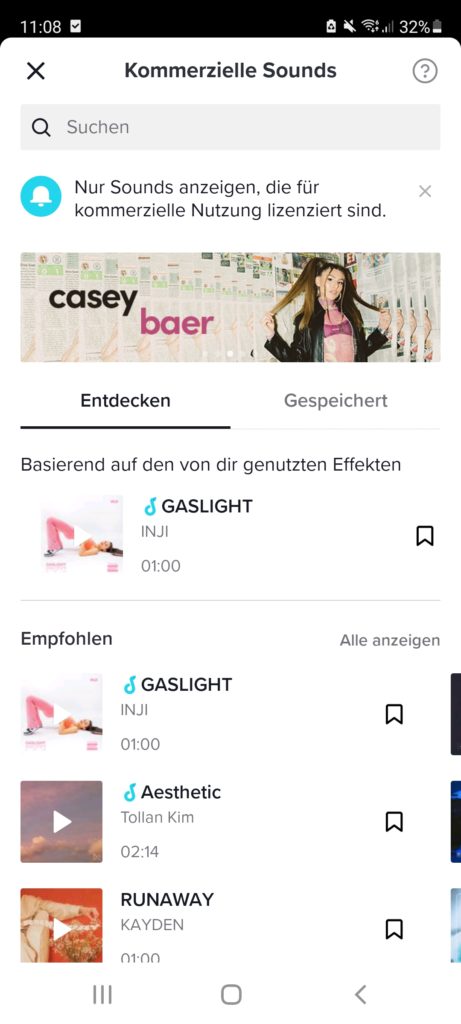
With a private account, you have access to the entire TikTok sound library. TikTok has created and continually expanded this sound library in order to make a large number of music titles available to users. And in 99.9% of cases, it has also been cleared or approved by the individual labels and publishers (directly via TikTok or via third-party partners). You can currently find this sound library in the app under Sounds. There you will also see that some tracks have been released for commercial use. In this case, commercial use means that you can also use it to distribute advertising content. For example, if you are an influencer and are promoting a product, you can use a song from the commercially released library without any problems.
However, you are not allowed to use a track that is not commercially released, this is your own responsibility in this case.
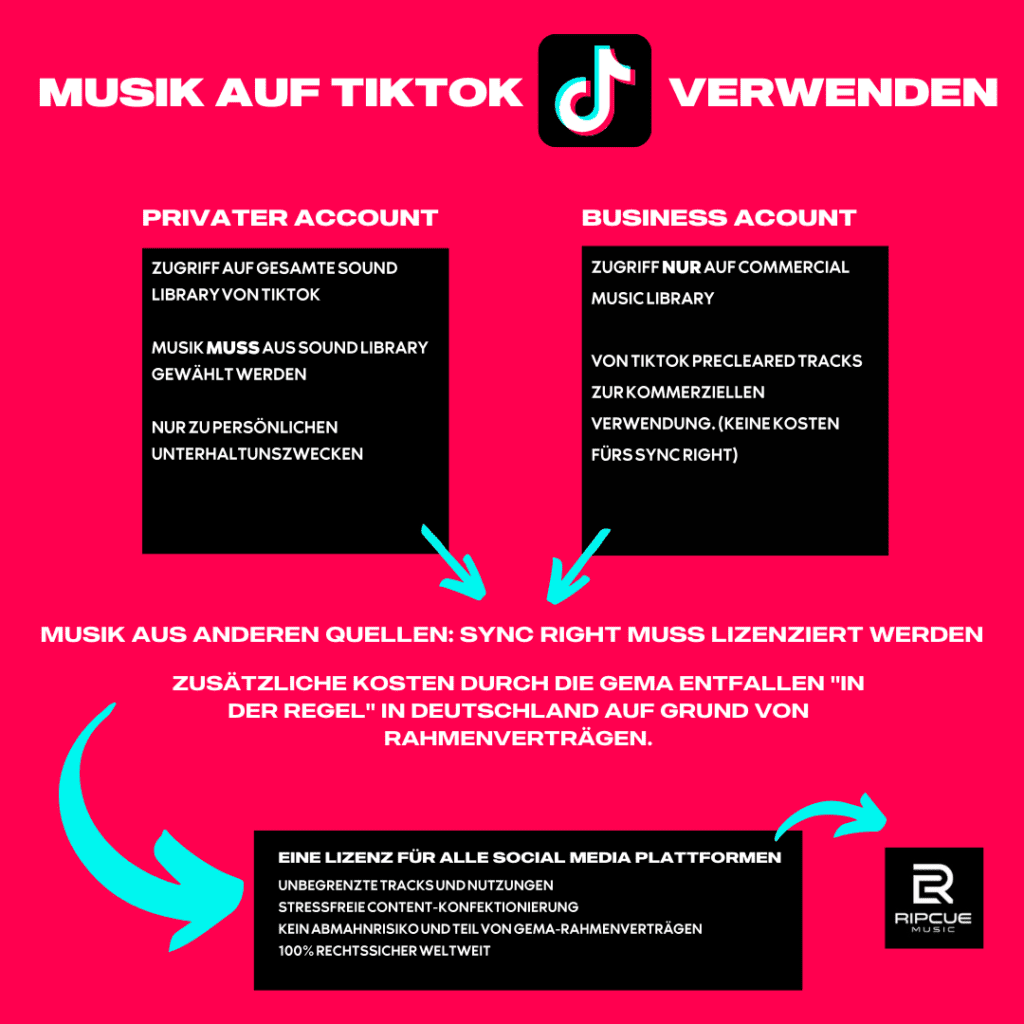
So in the private account you have access to the entire TikTok library, i.e. to different titles that are released for both commercial and non-commercial use.
Important: A song from the library must always be selected. There is absolutely no function that allows you to upload your own works (if the video is created in the app). This also means that if you want to use a specific track (which is not in the TikTok library) or you have already licensed/synced a specific music track(read all about the sync right in this article) that you want to use, then you cannot upload it and are forced to produce the video content outside of the app.
The tracks from the TikTok Sound Library, which are not commercially released, are also only released for personal and entertainment purposes. This means that you cannot create content that has an advertising character or refers to products or your own company. So if you have a business focus, for example as an influencer or you appear directly as a company, you can't really avoid the business account on TikTok.
Use music in your TikTok Business account
In the business account, access to the TikTok sound library is restricted to the tracks that are released for commercial use. This is understandable, as TikTok assumes that if you have a business account, your focus on the platform is 100% professional in nature and therefore the majority (if not all) of your videos are of a commercial nature. In this case, it is of course also important for the platform to protect itself legally. This release for commercial use is nothing more than a licensed sync right.
TikTok has cleared these synchronization rights with some publishers, partners and labels in advance. In other words, these are pre-cleared tracks that you can use within the platform without any problems. And now comes the important note "use on the platform" also means that it is not actually intended for the video to be downloaded and published on other platforms.
As I have already explained, distributing videos always carries the risk that you will use music tracks that have not been released for commercial use on other platforms. However, if you clear the rights in advance and produce outside of the app, you won't run into this problem, as you usually license all platforms at once.
Additional costs when using music on TikTok?
Now the question often arises as to whether additional costs are incurred if I use music on TikTok or other social media platforms in my content.
In Germany, GEMA has entered into framework agreements with all platforms. This means that there are no additional costs for performance rights or reproduction rights. GEMA takes the clear approach that in the current platform economy, the platform operators must also ensure that they have the necessary licenses. In the case of TikTok, there is an international agreement with the umbrella organization ICE(read here in Musikwoche). The same applies to the Meta Group (Facebook, Instagram, Whatsapp) and Google (YouTube).
However, this does not release the uploader from the obligation to ask a rights holder "whether" a title can be used. This is because the sync right must always be licensed.
With user-generated content, the focus may be on private use and a sync right is less relevant, but in a professional environment, licensing the synchronization right is mandatory. There is a big difference between whether I am allowed to use a track and which other music rights then have to be paid for. So the platform is generally responsible for paying for these rights and also for ensuring that the tracks are recognized accordingly.
This applies not only to TikTok, but also to YouTube, Facebook and Instagram. But of course this only applies to the repertoire that is also represented by GEMA.
Let's take the case of RipCue Music. We are a full GEMA member. If you purchase a Creators License from us, there are no additional costs for any other music rights. GEMA would have the additional framework agreement with the platforms and the platforms are then obliged to report the use of the music. We as the publisher and the composer then receive a (very) small portion of the royalties via GEMA.
Conclusion for the use of music on TikTok?
To summarize the quick win: You are always on the safe side if you use music that is provided by the platform itself and you really leave the content on the platform. After all, these titles have already been cleared and you won't have any additional problems. The disadvantage is, of course, that you are tied to this platform with your videos - intelligent content syndication is not effective (watermarks) and there may be problems with music rights. If the latter problems arise too often, this can, in the worst case, lead to your account being blocked (topic: YouTube Claim and Strikes).
I think the safest way is actually to produce all of your content outside of the platforms and also combine images and sound there. At best, you have a license that covers all social media channels or, even better, all digital platforms. You want to get the most out of your content, so a production outside of the platforms is all the better. Because you can also tailor the content perfectly for these channels, in the right size and fine-tune small details. You can create a consistent look, even musically, because you can use the same title for the same video.
So have fun producing and keep ripping,
Your Patrick